An American response to Winston Churchill on conservatism
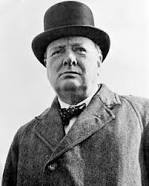 Without
accusing what was possibly one of the greatest minds of the twentieth
century as being nothing more than a drunk, excusing the fact that
his diminishing popularity was likely due to an ever increasing
conservatism (which will be explained shortly), and outright ignoring
the fact that this phrase is mistakenly attributed to him, Winston
Churchill makes a grave mistake in saying: "If you're not a
liberal when you're 25, you have no heart. If you're not a
conservative by the time you're 35, you have no brain."
Without
accusing what was possibly one of the greatest minds of the twentieth
century as being nothing more than a drunk, excusing the fact that
his diminishing popularity was likely due to an ever increasing
conservatism (which will be explained shortly), and outright ignoring
the fact that this phrase is mistakenly attributed to him, Winston
Churchill makes a grave mistake in saying: "If you're not a
liberal when you're 25, you have no heart. If you're not a
conservative by the time you're 35, you have no brain."
What
this quote ignores is the natural and historic tendency of political
and economic leanings and how they relate to the morphing society's
affect on the aging individual; in essence, progressivism naturally
challenges “the lifestyle” being that enhancement of all facets
of society and of living means a change at all the levels of living—
a perpetual alteration. The discomfort with this grows when we become
accustomed to a certain living style; as we are all members of a
culture or of a subculture, the “we” knows no bounds of economic
status, thus, the discomfort of change affects the poorest of us as
well as the richest of us. Where the commodity becomes a fetish, the
tendency of progressivism is a turnoff because we consider the
prospect of stagnancy (at best) or steady decline (at the worst) to
be greater than the idea of change at every turn (— interestingly,
this attitude seems to be contrary to the way the capital market is
designed to work). This
is essentially psychology on a grand scale; how does time affect the
individual's perception of reality? My grandfather once told me that
when he was my age, he thought that at his age society and government
would be entirely different, that it would be more forgiving to “the
small guy.” Working for decades at General Motors in Connecticut,
he understood the powerful infrastructure that he and his parents
were preparing for the future: technology, money, social programs,
new age culture, drive, service, specialty, wealth with no poverty, a
unified class. Now, he can't believe what he is seeing; things have
not just gone stagnant, they have become worse, and reality seems to
be very surreal for him and people of his generation.
My
grandfather is a liberal; he supports strong government programs for
the poor and working class, strong taxes for the rich, foreign
diplomacy over war, and large spending and reform in education. He
went into retirement for less than a few years after the plant closed
only to come back out to raise two of his grandkids with my
grandmother, and suddenly he needed to continue finding work (which
he was fortunate enough to do). No one has had to adapt to change
more than my grandparents, and they are just fine doing that. Why
can't change in our government and society serve people like this
and, more importantly, change the work ethic and education of those
who aren't so driven? The
reason why Churchill's quote is considered correct is because it is
always attributed to a single divine and/or logical truth when the
fact of the matter is that the prospect of attaining the individual,
single self interest (a la state of nature) guides the destiny of the
society— the idealism and societal goals set forth by not only our
forefathers, but our younger minds are trampled by the insecurity and
comfort of our elders. The idea and ideal of progressivism becomes
taboo along with what younger minds have to offer and sacrifices made
by hard working people are either ignored or considered expected of
everyone including those who are not equipped to do so.
So
when you find yourself growing increasingly defensive of the policies
and practices of yesteryear, reflect on your life choices and ask
yourself why. Do you have something to gain by putting a stop
to change in your society? If you don't have anything particular to
gain, ask yourself who does; if we can consider that, traditionally,
the bottom line is the dollar, then those who would not profit from
societal and political change are those who will fight the change.
And those who fight the change use propaganda to capitalize on the
discomfort that change inevitably creates in an individual. Instead
of empowering people to “do what feels right”, people are being
forced to react negatively to things that make them uncomfortable
rather than to facilitate the change and to acclimate. Close your
eyes for a moment and picture your life between the years of
twenty-five and forty (even if you fall into or beyond the range,
imagine how things have unfolded); you have to imagine all the
complexities of early life: first or second career or your fourth or
fifth dead-end job, college debt is in it's young years if you have
it and if you don't, maybe you have a slightly nicer apartment or car
than the average college student, but essentially you are in the same
position; in fact, maybe you're simply unemployed and desperate for
even a part time, minimum wage employment. By the time you're forty
you are settling into a routine, a specific kind of lifestyle; now
you probably have a serious relationship or partnership and you are
beginning to make good money— enough to buy a home or take on debt
to buy a home (if you haven't already).
Now
open your eyes. In your later years, things become easier in some
ways and harder in others and your memory starts becoming selective;
it begins to ignore moments or sentiments of the past because they no
longer serve your self-interest. Even if life isn't as you've
imagined it would be, you start accepting your disposition and you
become comfortable with it— in fact, you reach the point of
defending it.
Any
change to serve those currently in the position you used to be is
threatening if you're lead to believe it will only reduce you back to
that position or at the very least make your current state of being
unsustainable without further effort; a small part of you feels no
responsibility for those who are like you once were as those who used
to be where you currently are did for you. Ritual and habit becomes
easy and the added responsibility of the future generation and less
fortunate threatens the simplicity and/or comfort of your living.
This
is entirely justifiable; you are here, now, and you're not entirely
happy, but you are safe and comfortable. Future generations will be
able to do the same and the less fortunate will be able to follow
suit when they change the ways they make choices— voila, you are
now conservative.
That
being established, it is a sound assumption that the simplicity of
your living (or at least the comfort) is, in fact, threatened by
change. Social issues begin to take precedence in your political
leanings simply because this is not how things used to be, and things
used to be just fine for everyone. Some of the changes being made
aren't necessary at all, so shunning new ideas becomes second nature. Change
is inevitable, imminent, and perpetual whether we like it or not,
whether we are ready for it or not. Preservation of tradition and
tradition itself are admittedly important to the identity of a
culture and society, but sacrifices must be made to preserve the
underlying values and necessities that make the good society what is
good. A “get-what-you-deserve” society cannot exist within the
conditions our forefathers set before us because we already accept
that a life void of liberty and of the means to life is not
representative of the American dream; in other words, the most
successful and comfortable of us all must make sacrifices to allow
the less fortunate to thrive. Separately, to mark self-preservation
as an individual concern is foolhardy since the purpose of our
independence as a nation was its guarantee.
This
is the fallacy I find in Winston Churchill's supposed phrase. Though
it may only pertain to our society in the framework of my argument, I
still find us to be the greatest society of all, and all those
wanting for the good society should consider this argument.
~Joe

No comments:
Post a Comment