Tuesday, July 23, 2013

On Capitalism, Rousseau, Burke, and the American Jobs Act

Written September 16, 2011 when I thought I knew better than anyone. Still not a terrible piece of writing.
     Here's the deal: regardless of the economic plan (whether it be a liberal or conservative measure), if no spending happens, this plan will stop dead in its tracks. Being that we're still in a recession, despite any jobs that are created, all money earned is not going to be money spent. People will save and conserve because it is the fiscally responsible thing to do as an individual. This is the problem I have with capitalism; the collective depends on the individual abandoning self-interest. This is a living, breathing example of Rousseau-ian philosophy; to appeal to the General Will, the Particular Will won't necessarily prevail. This leaves room for the possibility that NO ONE'S Particular Will will be fulfilled. All at the cost of what? The current organization/structure that dictates actions day in and day out just because it works? This is also another example of modern conservatism: the only reasonable action for the individual is to save and conserve, but the good of the whole depends on the individual abandoning reason. This is what Burke, the father of conservatism, asks us to do; abandon reason as our motive to govern.  
     In conclusion, the American Jobs Act will not work because people will continue to save and conserve. I know I will. Once the failure of this is realized, then all we have left are lower taxes, inflation, and perhaps an even wider margin of debt. I suggest we do what billionaire Warren Buffet has suggested: raise taxes. There's no need to lower taxes for the rich, and that is what this plan entails. If we want to save capitalism (which in my personal opinion any effort would be in vain), then taxing the rich is a good place to start. Like the corporations our government loves so much, we need to be looking at the bottom dollar.

Friday, July 19, 2013

Who is guilty in the Trayvon Martin case?

     The sentiment among most people is that Trayvon Martin was up on trial— on trial for being African-American— and not George Zimmerman for being a murderer. What this means is that the question is no longer "did Zimmerman have to kill Martin?" or "was Zimmerman racially profiling Martin?" but it is now "did the court process racially profile Trayvon Martin?" In addition to that question, may we also ask if the court, and a large portion of America, also conducted themselves in a racist manner?
     When we are told by the 18th Judicial Circuit court of Florida that George Zimmerman is found "not guilty", what that means in our legal system is that there was not enough evidence to find him guilty, not that he wasn't guilty. Though many are frustrated and angered that the case didn't end the other way, we have to realize that a verdict finding Zimmerman guilty is not necessarily a verdict in favor of Trayvon Martin anymore.
     Let's face it, George Zimmerman could be guilty and he could not be guilty, but that's not what the case was about. It was about whether or not he had the right to engage in deadly force based upon the color of his attacker's skin. Yes, if he was attacked— by anyone of any color, for that matter— then he had the right to save his own life. As for whether his actions were warranted and as for whether or not the story was as he told it, that is the job of a court to decide. But to take those as a given and question Martin's level of danger for being black is abhorrent to say the least.
     So as insensitive as it may sound, we shouldn't be making this about the character of a man who was possibly acting upon instinct or possibly acting out of pure malice; we should be making this about how the court conducted itself, how the media conducted itself. For how can we know the truth behind the case, behind the man on trial if the court can't even consider the victim a human being?
     There are three very important things that everyone should see in light of this case. The first is the video to the left; it's a segment from ABC's show "What Would You Do?" It's shows how people will react to suspicious behavior in different circumstances. The second, is the video segment below from the film "A Time To Kill". You can also find the text version here: A Time To Kill Closing Argument. The final link that is so important for everyone to read, can be found here: Questlove, drummer of rock/hip-hop group The Roots, gives his take on the Trayvon Martin case. This essay deserves its own review and article and, to be honest, it should make the front page of every major newspaper in the United States.

Sunday, July 14, 2013

Palestinian population rising, settlements declining

     For the hell of it, I decided to look up "Israel Palestine statistics" because I felt like writing a small article on the happenings in Israel and my own take on them. Well, I found a graph showing the rise in population of the West Bank and Gaza Strip, and it made me question how in the hell this graph even works compared to a map of Israel that I found illustrating how both areas are becoming smaller and smaller in recent years.

     If both figures are true, then we can see how easy allegations of genocide would be. Think about it: if the settlements of Palestinians are falling while the population is rising, how would anyone ever keep track of a hypothetical mass disappearance? Now, I'm not saying I believe the Israeli military is exactly that hypocritical, but with Palestinian populations rising as drastically as the respective loss of land, it is hard to imagine these people not living in a shoulder to shoulder environment. Furthermore, if living conditions are forced to be as bad as concentration camps or low budget military housing, then it is equally as hard to imagine how these people find the opportunity to make a living.
     If I haven't committed "anti-Semitism" (as it seems lately to loosely be thrown around by Israeli government officials) in this article, then I will no doubt offend politically conservative Jews twofold by addressing the ultimate hypocrisy in this whole issue. When asked what Israel's problem is— economically, politically, religiously— the answer that is typically given is "the Palestinians". The sentiment among conservative leaning Jewish Israelis is that Palestinians are deserving of death, of being driven off "land that isn't theirs" (note: this land was settled by non-Jews, the same people who resided there until this past century. Also note: the people who settled this land weren't even Muslims when they originally settled it); they tend to believe that Palestinians are completely below them and that it's an Israeli's duty not to be merciful, but relentless in removing these people. I know it's quite cliche at this point to ask it, but I will ask it anyway: doesn't this sound all too familiar? Can we recall a place in recent history that we were forced, as a globe, to address such an issue? I'll let the reader read between the lines, there. 
     A more subtle similarity is to the former apartheid regime in South Africa that was overcome by Nelson Mandela, the African National Congress, and other African socio-political revolutionaries. From 1948 to 1994, the National Party ruled and enforced laws that gave priority to the Caucasian majority and subjected the Afrikaner minority to a second class status. 
     To mark the process of Palestinian voting opportunity as being a "difficult" and "sensitive" issue is quite the understatement. Besides making a trip to the voting booth next to impossible for the average Palestinian, walls have been built not only around Palestinian settlements, but through more and more which is why we see the West Bank breaking apart like ice sheets in the Arctic Sea. In addition to all the unfortunate living conditions being imposed upon the Palestinians, they are also subjected to a version of racism comparable not even to racism of the 1960's in the United States.
     So I will ask the most obvious question there can be: if the numbers of Arab-Israelis and Palestinians are going up, then why have the living conditions gotten worse only for these people? Why have elections not favored a growing minority even in the slightest (proportionately)? Furthermore, why is everyone standing by for this?
~Joe

Thursday, July 11, 2013

A Day of Martial Law

     If you ask a conspiracy theorist about the recent bombing in Boston, one of the first things they may tell you is that it was set up by the government to practice Martial Law. Since I love this country and I have faith in our government to conduct itself fairly and legally, I'm willing to let the first part of that theory go. It is the second part, however, which is causing me to question what happened exactly.
     If there were an untested protocol, a method of conduct for a dangerous situation how would we know it would work? Obviously, such a method must be used in practicum to rule whether or not it will work. In Boston, we saw a very intricate response to the two bombing suspects and it should cause us to think about how necessary it all was.
     For those fateful days in April, people in Boston were asked to stay in their homes and lock their doors while the Federal, State, and local police hunted down the nineteen-year-old suspect. I do not believe any information on the total number of police involved, artillery, and equipment have been released, but judging by the looks of Boston for those days in question, it seems to be overkill for a single person. Yes, it is a dangerous situation and, as an acquaintance pointed out to me earlier, the last thing we would want is a manhunt in Boston's rush-hour traffic. Not to mention, the Federal Bureau of Investigation, Governor Patrick, and the state and local police only asked people to stay indoors; that is to say that unless Martial Law was officially declared, the people were allowed to follow their government's suggestion at their own discretion.
     This is what is so worrying to me. The day of and the days following the bombing, we witnessed how people will react to a certain type of response to terror on our own soil. Compared to 9/11, the terror at the Boston Marathon, though tragic, was a minimum; it wasn't the chaos and temporary anarchy that New York was for the weeks following the attack. New York was practically a battlefield while Boston, though in peril, was tame— well, as tame as Boston can be. Had Martial law been declared in both situations, New York would have been next to impossible to control while Boston would have been a cakewalk, and not because Boston is smaller, but because it was compliant with the requests of the government.
     This is not to say that the people should not have been compliant or that they had any reason to distrust their government, though efforts to capture the culprits were drastic and perhaps over the top, it was probably just as easy allowing the police do what they do without getting in their way. My personal concern, however, is that people will grow used to allowing this anytime for anything. We must stand against violence in every form and, in avoidance of siding with either Martin Luther King Jr. or Malcolm X, suffice it to say that violence should be battled with intolerance— however you, the reader, may take that notion.
~Joe

Wednesday, July 10, 2013

The Tea Party: Guardians of the Constitution

     The very nature of our country's design was to raise the bar of forward thinking-- that is, liberty, equality, and justice for all. The disagreement between the right and the left lies within what ought to be considered civil liberty and/or what we guarantee as rights to be protected through our government.
     The Tea Party is a group of conservative thought who pride themselves as scholars of the United States Constitution and for defending it against the whim of the collective leftist. In other words, Tea Party people are textualists-- people who take the original document how it was written, word for word and not for what it may or may not have meant. Any claims made about the intent of the original document are promptly stomped out by the simple and indiscriminate idea that the written word means what it means as it lies written on the page.
     When the liberal attempts to provide a justification for something in the Constitution-- whether provable or not-- there is a deterioration of thought and argument, thereby belief, thereby reality. The conservative will defend the Constitution by providing a textual argument from a part of it and the liberal therefore submits his own textual evidence to the contrary and it only creates confusion when we cannot conclude a winning argument because we have essentially created conflict in the Constitution itself.
     The difference between the two sides is that the liberal finds a need to be inclusive while the conservative maintains that there can be no need. While we can fault the liberal for attempting to trace the original meaning of our forefathers, the conservative— who does not consider the need already being accounted for— attempts to use anything but the prejudice that rules their being to seek an end to the argument. Furthermore, we should consider the liberal at fault simply because he or she attempts to engage in the same prejudices as the forefathers (which may or may not be even worse than the prejudices of present conservatives).
     In the end, both parties, both philosophies tread on a most freeing ideology by attempting to defend it. One makes the mistake of objectifying his philosophy and the other by subjecting all to his own prejudice. If nothing could not possibly possess contradiction, then the Tea Party is a group of people not interested in having a logical and practical government and society (in fact, if the Constitution was meant never to hold contradiction, then amendments would never have been possible).
     The Tea Party is as much a guardian of the constitution as New York was any practical help to establishing independence from Britain. Comfort in the ways of the old makes it such an easy argument to prevent forward moving and forward thinking.
     How is a nation forward moving when the ideals it is built on are immovable and non-progressive? People concern themselves with how slow the economy seems to be moving and how unproductive our political representatives seem to be on all different fronts, but no one seems interested in the notion that nothing moves because no one attempts to test both figurative and literal inertia.
     The art of forward thinking is overcoming historical prejudice and that requires not a change in the Constitution, but actually defining what liberty and equality mean today. It will force those who embrace textualism to resort to none-other than their prejudices and, as Burke said, wait until the prejudice dwindles to a minority. Our current duty is not to continue our forefathers' thought, but to parallel it in the context of the present for the sake of liberty and equality.
~Joe

A very, very brief comment on liberty: meaning and common usage


     "I have the liberty…"— this is something most of us hear all too frequently, and it's usage is usually attached to a negative. That is, when somebody feels the need to state their "liberties" to something, it's because someone has informed them otherwise. It is a fact that the reader must acknowledge, however, that people have their mortal and socio-political "liberties" at stake when they refer to liberty and freedom as one in the same. Let it be clear that liberty and freedom are not one in the same.
     If we use etymology to trace the origins of the words, we find that liberty comes to mean the condition of a free man, the absence of restraint— in positive and singular terms: permission. Freedom is more or less a compound of Olde English/Old Germanic words; "free" means to be exempt from, not in bondage, or joy, peace, kinship, love while "dom" means statute or judgment. To draw the difference between liberty and freedom, the former means permission while the latter means a statute of exemption or peace. Furthermore, as we have already gone over, liberty historically means the condition of a free man, so we can draw such a distinction: liberty is a condition dependent on how free man is.
    Modern western philosophy (from the pre-Declaration era to the post-French Revolution era) left liberty highly in debate. Hobbes, Locke, and Rousseau could agree on few things, but one agreement was that the establishment of government is natural to human nature and a necessity. The weak need protection from the strong in the state of nature which is, in a nutshell, the anarchic state of affairs before society comes to this consensus (an all too brief definition of "state of nature" for those not privy to it). In essence, the social order rising from the state of nature sacrifices certain freedoms for some to ensure basic freedoms for all.
     We can see, now, that because liberty (permission) necessitates some freedoms (statutes of exemption) to be exchanged, that there may be some actions that cannot be had on part of the individual. So the next time someone tells you that "they have the liberty…" you can tell them one of two things: you can be a coy smart-ass, cut them off at those words and say, "oh, so do I!" or you can be equally as bodacious by correcting them, "what you mean is that you have the freedom… and, actually, chances are, you don't." However absurd the law may be, no one is exempt from it, and it seems our definitions of freedom and liberty have made confusing issues for us ever since civil liberties have been an issue in this country (separately, any debate on the definitions of "liberty", "freedom", and "equality" leads to an undermining of what, or who, defines a human).
     To the First Amendment lovers— a professor of American Government or Civil Liberties would know right off what a brief Google search refreshed my memory of, but not anything can be said (much less done). Among the "speech" not protected by the amendment are: hate speech, speech/coercion leading others to commit illegal activity, material support, public speech made in the conduct of public duty, slander/libel/defamation, plagiarism or publishing confidential information, and true threats. Like most of our mothers tell us when we are young, it would be most advisable to think before we say— in the case of most, if one feels as though they ought to remind others of their freedoms, there is a good chance that they may not actually have the freedom to do so (though this often goes unpunished— think of all the arrests that would have to be made if everyone stating President Obama is not an American were to be punished!)
     The subject of liberty is a very broad one which cannot truly be addressed on all the levels required to clarify for everyone once and for all. Liberty is sometimes seen as a very individual concern, a subjective matter, and as much as so many wish this were not true, it, in fact, may be. Considering the vastness of what liberty actually is and, ironically, the limitation of its understanding, it would come as no surprise that mastering the meaning would come differently to every person as snowflakes do to the ground. If we also consider the aforementioned "state of nature" argument, then this can only make more sense in that if everyone has their own sense of justice, then they will conduct themselves according to their own sense of liberty— morality not being a universal will show action on the part of others in a variety of ways.
~Joe

Friday, July 5, 2013

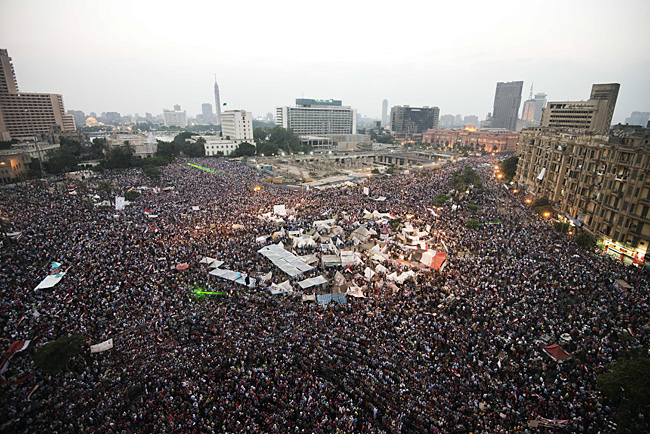
Democracy a no go in Cairo

     “You either die a hero, or you live long enough to see yourself become the villain”; Mohamed Morsi is officially irrelevant in the lives of Egyptians. “Come here O Sisi,” a protestor's flag beckoned the attention of the military's general, “Morsi isn't my president.” General Abdul Fattah al-Sisi lived up to his promise just two days ago that the military would aid the protesters in overthrowing the president; he announced only hours ago that Morsi is no longer in office, that the constitution is now suspended, and that the head of the Supreme Constitutional Court, Adli al-Mansour will act as interim head of state. Sisi stated that while Mansour will temporarily serve as the head of state, he wishes to quickly move forward with early presidential and parliamentary elections, a panel to review the constitution, and a national reconciliation committee designed to bring all groups together to move the country forward.
     The last four days in Cairo outside the Presidential Palace have marked record breaking protests with millions of people in attendance, but statistics of a different nature have indicated a digression from the main purpose of the movement; around 46 sexual assaults have been reported as well as the death of sixteen people and around 780 people sustaining injuries. Despite the alarming statistics, protestors have proclaimed that this is a resistance held in civil disobedience and that such actions are unacceptable and damaging in Egypt's new fight for a fair democracy.
     As Morsi supporters— who happen largely to be proponents of the Muslim Brotherhood— have illustrated, the voices of the people were answered when Morsi was elected by over 13 million votes last June. However, as emotions tend to run wild when freedom and liberty can be just as easily lost as they are won, Morsi and the Muslim Brotherhood were seen as the necessary option for presidency considering their large role in reclaiming the country in 2011 from Hasni Mubarek, former dictator of Egypt (recall the evolution of France's 3rd, 4th, and 5th Republics).
     A year to change not only a political climate, but a socio-economic climate is a very small time frame for a very large task. But is this movement against Egypt's first democratically elected president in years a show of restlessness and rejection of democracy or is it a period of enlightenment for the people of Egypt? That is, have the people of Egypt come to the realization that their revolutionary heroes may not necessarily be suitable to lead their new government? This is a consideration that democracy has not at all failed, that, in fact, it has not yet prevailed for Egypt. For a people who are still used to and who are still in reminiscence of dictatorship, perhaps graduality is a bit much to ask and a more radical change is in order when leadership fails.
     President Morsi's only response to his expulsion is rejection— that the military has formed a coup against him and that he is still Egypt's leader. In addition, President Morsi explicitly instructs the people of Egypt to abide by the constitution while matters are being settled. Though General Sisi has suspended the constitution and though Morsi may not realize the implications of his words, this indicates to the people that their inalienable rights are still to be taken seriously. Such a message seems to be exactly what the leaders of every great nation convey whether they continue to hold power or not. In essence, Morsi is conveying to the people that their rights are more important than his dispute with them and the military.
     What we are seeing in Egypt right now is the failure of a cabinet much like failures we have seen in our own political history (the Nixon and Clinton impeachments). This does not necessarily mean Egypt is becoming anti-democracy or anti-government— they are simply anti-Morsi-government. They have found that the elections of June 2012 were a grave mistake and their civil demonstrations should show that they wish to correct this mistake.
     After nearly a week of unrest, Mansour will be sworn in tomorrow, Thursday, July 4, and a new, albeit brief chapter will begin for Egypt and its people.
~ Joe