 “You
either die a hero, or you live long enough to see yourself become the
villain”; Mohamed Morsi is officially irrelevant in the lives of
Egyptians. “Come here O Sisi,” a protestor's flag beckoned the
attention of the military's general, “Morsi isn't my president.”
General Abdul Fattah al-Sisi lived up to his promise just two days
ago that the military would aid the protesters in overthrowing the
president; he announced only hours ago that Morsi is no longer in
office, that the constitution is now suspended, and that the head of
the Supreme Constitutional Court, Adli al-Mansour will act as interim
head of state. Sisi stated that while Mansour will temporarily serve
as the head of state, he wishes to quickly move forward with early
presidential and parliamentary elections, a panel to review the
constitution, and
a national reconciliation committee designed to bring all groups
together to move the country forward.
“You
either die a hero, or you live long enough to see yourself become the
villain”; Mohamed Morsi is officially irrelevant in the lives of
Egyptians. “Come here O Sisi,” a protestor's flag beckoned the
attention of the military's general, “Morsi isn't my president.”
General Abdul Fattah al-Sisi lived up to his promise just two days
ago that the military would aid the protesters in overthrowing the
president; he announced only hours ago that Morsi is no longer in
office, that the constitution is now suspended, and that the head of
the Supreme Constitutional Court, Adli al-Mansour will act as interim
head of state. Sisi stated that while Mansour will temporarily serve
as the head of state, he wishes to quickly move forward with early
presidential and parliamentary elections, a panel to review the
constitution, and
a national reconciliation committee designed to bring all groups
together to move the country forward.
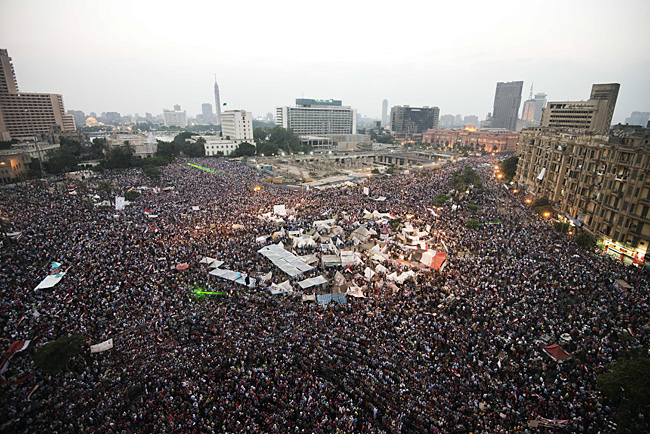
The
last four days in Cairo outside the Presidential Palace have marked
record breaking protests with millions of people in attendance, but
statistics of a different nature have indicated a digression from the
main purpose of the movement; around 46 sexual assaults have been
reported as well as the death of sixteen people and around 780 people
sustaining injuries. Despite the alarming statistics, protestors have
proclaimed that this is a resistance held in civil disobedience and
that such actions are unacceptable and damaging in Egypt's new fight
for a fair democracy.
As
Morsi supporters— who happen largely to be proponents of the Muslim
Brotherhood— have illustrated, the voices of the people were
answered when Morsi was elected by over 13 million votes last June.
However, as emotions tend to run wild when freedom and liberty can be
just as easily lost as they are won, Morsi and the Muslim Brotherhood
were seen as the necessary option for presidency considering their
large role in reclaiming the country in 2011 from Hasni Mubarek,
former dictator of Egypt (recall the evolution of France's 3rd,
4th,
and 5th
Republics).
A
year to change not only a political climate, but a socio-economic
climate is a very small time frame for a very large task. But is this
movement against Egypt's first democratically elected president in
years a show of restlessness and rejection of democracy or is it a
period of enlightenment for the people of Egypt? That is, have the
people of Egypt come to the realization that their revolutionary
heroes may not necessarily be suitable to lead their new government?
This is a consideration that democracy has not at all failed, that,
in fact, it has not yet prevailed for Egypt. For a people who are
still used to and who are still in reminiscence of dictatorship,
perhaps graduality is a bit much to ask and a more radical change is
in order when leadership fails.
President
Morsi's only response to his expulsion is rejection— that the
military has formed a coup against him and that he is still Egypt's
leader. In addition, President Morsi explicitly instructs the people
of Egypt to abide by the constitution while matters are being
settled. Though General Sisi has suspended the constitution and
though Morsi may not realize the implications of his words, this
indicates to the people that their inalienable rights are still to be
taken seriously. Such a message seems to be exactly what the leaders
of every great nation convey whether they continue to hold power or
not. In essence, Morsi is conveying to the people that their rights
are more important than his dispute with them and the military.
What
we are seeing in Egypt right now is the failure of a cabinet much
like failures we have seen in our own political history (the Nixon
and Clinton impeachments). This does not necessarily mean Egypt is becoming anti-democracy or anti-government— they are simply
anti-Morsi-government. They have found that the elections of June
2012 were a grave mistake and their civil demonstrations should show
that they wish to correct this mistake.
After
nearly a week of unrest, Mansour will be sworn in tomorrow, Thursday,
July 4, and a new, albeit brief chapter will begin for Egypt and its
people.
~ Joe

Note that this was written on Wednesday and uploaded today!
ReplyDelete