Showing posts with label President Obama. Show all posts

Saturday, April 5, 2014

Hollywood

I am an unabashed admirer of Hollywood. What “grinds my gears” as the infamous Peter Griffin would say, is what that implies to others. When I say “I love Hollywood”, people tend to think of reality television, MTV, VH1, all the ABC Family and CW teen dramas, anything involving the lives of celebrities, Fox News, perhaps MSNBC, and media in general. Let’s get one thing, no, several things straight; President Obama, if we may call him a celebrity, is not an actor (okay, well, maybe an actor of a different sort); whether shake cams grasp the uninteresting lives of New Jersey and South Beach alcoholics or not does not interest me; when Republicans force the shutdown of the government and Fox News dubs it a “slimdown” to make it sound less ominous, I am not thinking about the BAFTA Awards or Los Angeles Film Festival; when Kate Gosselin announces her twenty-somethingth child, I am even less interested than when Gwyneth Paltrow announces her third. If you can see where I am going with this, then I need not continue with the examples.
     One thing that bears mentioning is that the aforementioned examples or scenarios do, in fact, concern me as a human being first and foremost, and as an American. What I do not appreciate is the fact that I must do more than just explain what it is, exactly, that I love about Hollywood, but that I must defend myself. No one has to muster a defense for loving literature or theatre (at least no one should have to), so why must I defend my love of Hollywood and film? The answer is unfortunately simple; today, film, media, and world affairs are all closely related, at best, if not completely intertwined. Film is as direct to the minds of the people as commercials and news and the politics of everyone’s respectful representatives. Film can be used as propaganda telling us what we need to stand for or against and it is just as prone to ignorance and distraction as the rest of media and its coverage.
     When film becomes unarguably artful, when it puts down the gavel to experiment with the intimacy of personal life and I must continue to defend my position on Hollywood, that’s where I really snap. I suppose I dig myself a shallow grave when I say I enjoy the films of Woody Allen and Roman Polanski. Yes, yes, we can argue that the former may or may not be guilty of being the worst of our society and, thus, his character remains ambiguous enough to admire, but we all know the latter is guilty of the crime considering, well, everything surrounding him. But their work deserves a different light. We wouldn’t say the same of Jack the Ripper and his “work”, and if we were to find an equivalent in film we could not find one; if we were to find out, one day, that Michael Bay was involved in snuff film, then maybe we would have a comparison to consider. When I cannot enjoy an art-house film because people want to play judge, jury, and executioner, I get a little upset. If Woody Allen can be brought up on charges, found guilty in a fair trial by an impartial jury, and serve jail time, if Roman Polanski can be extradited to the United States to face the full wrath of the American justice system, I have no complaints— justice is highly important. But I will not stand to see art put up on trial in a courtroom or in the media.
     In short and in general, I am speaking of the life form of film, Hollywood, and film as art and the writers, directors, actors, makeup and lighting artists, photographers, and set designers who collaborate to bring us art. I hope this explanation makes others think differently of the question, "What does it mean to be an admirer of Hollywood?" Is it really drama breaking the fourth wall or how that appeals to the idea that “this can be me one day”? Or is it the character or the actor? Is it the story or the writing? The special effects that can only exist on the screen? Is it simply and generally the awe of the power that it holds over people? It is truly a loaded question, a personal question, and there is just so much more to say about it than "I like that movie."


Tuesday, July 23, 2013

On Capitalism, Rousseau, Burke, and the American Jobs Act

Written September 16, 2011 when I thought I knew better than anyone. Still not a terrible piece of writing.
     Here's the deal: regardless of the economic plan (whether it be a liberal or conservative measure), if no spending happens, this plan will stop dead in its tracks. Being that we're still in a recession, despite any jobs that are created, all money earned is not going to be money spent. People will save and conserve because it is the fiscally responsible thing to do as an individual. This is the problem I have with capitalism; the collective depends on the individual abandoning self-interest. This is a living, breathing example of Rousseau-ian philosophy; to appeal to the General Will, the Particular Will won't necessarily prevail. This leaves room for the possibility that NO ONE'S Particular Will will be fulfilled. All at the cost of what? The current organization/structure that dictates actions day in and day out just because it works? This is also another example of modern conservatism: the only reasonable action for the individual is to save and conserve, but the good of the whole depends on the individual abandoning reason. This is what Burke, the father of conservatism, asks us to do; abandon reason as our motive to govern.  
     In conclusion, the American Jobs Act will not work because people will continue to save and conserve. I know I will. Once the failure of this is realized, then all we have left are lower taxes, inflation, and perhaps an even wider margin of debt. I suggest we do what billionaire Warren Buffet has suggested: raise taxes. There's no need to lower taxes for the rich, and that is what this plan entails. If we want to save capitalism (which in my personal opinion any effort would be in vain), then taxing the rich is a good place to start. Like the corporations our government loves so much, we need to be looking at the bottom dollar.

Thursday, July 11, 2013

A Day of Martial Law

     If you ask a conspiracy theorist about the recent bombing in Boston, one of the first things they may tell you is that it was set up by the government to practice Martial Law. Since I love this country and I have faith in our government to conduct itself fairly and legally, I'm willing to let the first part of that theory go. It is the second part, however, which is causing me to question what happened exactly.
     If there were an untested protocol, a method of conduct for a dangerous situation how would we know it would work? Obviously, such a method must be used in practicum to rule whether or not it will work. In Boston, we saw a very intricate response to the two bombing suspects and it should cause us to think about how necessary it all was.
     For those fateful days in April, people in Boston were asked to stay in their homes and lock their doors while the Federal, State, and local police hunted down the nineteen-year-old suspect. I do not believe any information on the total number of police involved, artillery, and equipment have been released, but judging by the looks of Boston for those days in question, it seems to be overkill for a single person. Yes, it is a dangerous situation and, as an acquaintance pointed out to me earlier, the last thing we would want is a manhunt in Boston's rush-hour traffic. Not to mention, the Federal Bureau of Investigation, Governor Patrick, and the state and local police only asked people to stay indoors; that is to say that unless Martial Law was officially declared, the people were allowed to follow their government's suggestion at their own discretion.
     This is what is so worrying to me. The day of and the days following the bombing, we witnessed how people will react to a certain type of response to terror on our own soil. Compared to 9/11, the terror at the Boston Marathon, though tragic, was a minimum; it wasn't the chaos and temporary anarchy that New York was for the weeks following the attack. New York was practically a battlefield while Boston, though in peril, was tame— well, as tame as Boston can be. Had Martial law been declared in both situations, New York would have been next to impossible to control while Boston would have been a cakewalk, and not because Boston is smaller, but because it was compliant with the requests of the government.
     This is not to say that the people should not have been compliant or that they had any reason to distrust their government, though efforts to capture the culprits were drastic and perhaps over the top, it was probably just as easy allowing the police do what they do without getting in their way. My personal concern, however, is that people will grow used to allowing this anytime for anything. We must stand against violence in every form and, in avoidance of siding with either Martin Luther King Jr. or Malcolm X, suffice it to say that violence should be battled with intolerance— however you, the reader, may take that notion.
~Joe

Wednesday, July 10, 2013

The Tea Party: Guardians of the Constitution

     The very nature of our country's design was to raise the bar of forward thinking-- that is, liberty, equality, and justice for all. The disagreement between the right and the left lies within what ought to be considered civil liberty and/or what we guarantee as rights to be protected through our government.
     The Tea Party is a group of conservative thought who pride themselves as scholars of the United States Constitution and for defending it against the whim of the collective leftist. In other words, Tea Party people are textualists-- people who take the original document how it was written, word for word and not for what it may or may not have meant. Any claims made about the intent of the original document are promptly stomped out by the simple and indiscriminate idea that the written word means what it means as it lies written on the page.
     When the liberal attempts to provide a justification for something in the Constitution-- whether provable or not-- there is a deterioration of thought and argument, thereby belief, thereby reality. The conservative will defend the Constitution by providing a textual argument from a part of it and the liberal therefore submits his own textual evidence to the contrary and it only creates confusion when we cannot conclude a winning argument because we have essentially created conflict in the Constitution itself.
     The difference between the two sides is that the liberal finds a need to be inclusive while the conservative maintains that there can be no need. While we can fault the liberal for attempting to trace the original meaning of our forefathers, the conservative— who does not consider the need already being accounted for— attempts to use anything but the prejudice that rules their being to seek an end to the argument. Furthermore, we should consider the liberal at fault simply because he or she attempts to engage in the same prejudices as the forefathers (which may or may not be even worse than the prejudices of present conservatives).
     In the end, both parties, both philosophies tread on a most freeing ideology by attempting to defend it. One makes the mistake of objectifying his philosophy and the other by subjecting all to his own prejudice. If nothing could not possibly possess contradiction, then the Tea Party is a group of people not interested in having a logical and practical government and society (in fact, if the Constitution was meant never to hold contradiction, then amendments would never have been possible).
     The Tea Party is as much a guardian of the constitution as New York was any practical help to establishing independence from Britain. Comfort in the ways of the old makes it such an easy argument to prevent forward moving and forward thinking.
     How is a nation forward moving when the ideals it is built on are immovable and non-progressive? People concern themselves with how slow the economy seems to be moving and how unproductive our political representatives seem to be on all different fronts, but no one seems interested in the notion that nothing moves because no one attempts to test both figurative and literal inertia.
     The art of forward thinking is overcoming historical prejudice and that requires not a change in the Constitution, but actually defining what liberty and equality mean today. It will force those who embrace textualism to resort to none-other than their prejudices and, as Burke said, wait until the prejudice dwindles to a minority. Our current duty is not to continue our forefathers' thought, but to parallel it in the context of the present for the sake of liberty and equality.
~Joe

A very, very brief comment on liberty: meaning and common usage


     "I have the liberty…"— this is something most of us hear all too frequently, and it's usage is usually attached to a negative. That is, when somebody feels the need to state their "liberties" to something, it's because someone has informed them otherwise. It is a fact that the reader must acknowledge, however, that people have their mortal and socio-political "liberties" at stake when they refer to liberty and freedom as one in the same. Let it be clear that liberty and freedom are not one in the same.
     If we use etymology to trace the origins of the words, we find that liberty comes to mean the condition of a free man, the absence of restraint— in positive and singular terms: permission. Freedom is more or less a compound of Olde English/Old Germanic words; "free" means to be exempt from, not in bondage, or joy, peace, kinship, love while "dom" means statute or judgment. To draw the difference between liberty and freedom, the former means permission while the latter means a statute of exemption or peace. Furthermore, as we have already gone over, liberty historically means the condition of a free man, so we can draw such a distinction: liberty is a condition dependent on how free man is.
    Modern western philosophy (from the pre-Declaration era to the post-French Revolution era) left liberty highly in debate. Hobbes, Locke, and Rousseau could agree on few things, but one agreement was that the establishment of government is natural to human nature and a necessity. The weak need protection from the strong in the state of nature which is, in a nutshell, the anarchic state of affairs before society comes to this consensus (an all too brief definition of "state of nature" for those not privy to it). In essence, the social order rising from the state of nature sacrifices certain freedoms for some to ensure basic freedoms for all.
     We can see, now, that because liberty (permission) necessitates some freedoms (statutes of exemption) to be exchanged, that there may be some actions that cannot be had on part of the individual. So the next time someone tells you that "they have the liberty…" you can tell them one of two things: you can be a coy smart-ass, cut them off at those words and say, "oh, so do I!" or you can be equally as bodacious by correcting them, "what you mean is that you have the freedom… and, actually, chances are, you don't." However absurd the law may be, no one is exempt from it, and it seems our definitions of freedom and liberty have made confusing issues for us ever since civil liberties have been an issue in this country (separately, any debate on the definitions of "liberty", "freedom", and "equality" leads to an undermining of what, or who, defines a human).
     To the First Amendment lovers— a professor of American Government or Civil Liberties would know right off what a brief Google search refreshed my memory of, but not anything can be said (much less done). Among the "speech" not protected by the amendment are: hate speech, speech/coercion leading others to commit illegal activity, material support, public speech made in the conduct of public duty, slander/libel/defamation, plagiarism or publishing confidential information, and true threats. Like most of our mothers tell us when we are young, it would be most advisable to think before we say— in the case of most, if one feels as though they ought to remind others of their freedoms, there is a good chance that they may not actually have the freedom to do so (though this often goes unpunished— think of all the arrests that would have to be made if everyone stating President Obama is not an American were to be punished!)
     The subject of liberty is a very broad one which cannot truly be addressed on all the levels required to clarify for everyone once and for all. Liberty is sometimes seen as a very individual concern, a subjective matter, and as much as so many wish this were not true, it, in fact, may be. Considering the vastness of what liberty actually is and, ironically, the limitation of its understanding, it would come as no surprise that mastering the meaning would come differently to every person as snowflakes do to the ground. If we also consider the aforementioned "state of nature" argument, then this can only make more sense in that if everyone has their own sense of justice, then they will conduct themselves according to their own sense of liberty— morality not being a universal will show action on the part of others in a variety of ways.
~Joe

Tuesday, April 16, 2013

On the Boston Marathon Massacre


     In the twenty-first century, evil hath no face. The general prejudice of Americans— particularly white Americans— causes us to picture brown skinned, turban wearing individuals who believe in Allah (simply Arabic for Yahweh, which is Hebrew for God). 
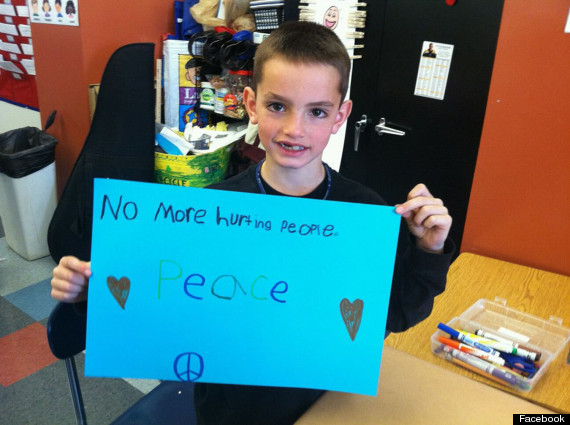
     Prejudice aside, we have absolutely no idea who is guilty of the terror at the Boston Marathon. Earlier today, I saw a picture of the child who was killed on Boylston Street and I found myself haunted not by the death of a child holding a sign that says "No more hurting people; peace", but by the apathy toward this tragedy and my own struggle with a severe disconnect to the violence. For the sake of brevity, in the case this act of terror is found to come from an individual who is domestic, American born, and perhaps even white, what I propose is that we as Americans are to blame for we have become entirely unmoved by violence and the horror violence creates. 
     It will be easy to condemn a foreign entity with foreign agents of terror, but what are we going to say if it happens to be an American? Furthermore, what are we going to say when we are forced to ask ourselves how different this is from the Colorado Shooting or other atrocities especially if those involved do not suffer from mental health issues, but from indoctrination? 
     A second set of questions: "who do we blame?" and "who do we kill?" The killing cannot stop at Boylston Street if we seek justice as we understand it in the law books  But in a spiritual sense, are we willing to send these individuals to their virgins? Or, if that was not the case, how many should be sent to their deaths to obtain justice for those who have been murdered? The pursuit of justice, in this case, should be inflection and change in our hearts, to stop violence when we see it, and to put a stop to the ever increasing sociopathic tendencies toward violence. We should confront ourselves with these things in the attempt to dissolve them completely. 
     President Obama referred to this attack as a tragedy and he has been hounded by news syndicates to condemn it further, to upgrade it from "tragedy" to something else— an "act of terror" or some such over used, over glorified phrase. That is the problem. We are already so disconnected from the tragedy, we seek to call it something else and to defend it to the end simply because we are becoming less and less able to empathize with the victims. This is a tragedy and people need to get upset over it and grieve for humanity as a whole rather than letting it fuel their prejudices and serve as entertainment to their boredom. 
     In the twenty-first century, evil begets apathy, thus evil reigns with a swift dominance of the globe. It coasts effortlessly like a feather in a vacuum gives way to Earth's gravity. The compassion we once had as a species, though still present in certain circumstances, was once a friction to violence and the evil born from it.
~ Joe