Friday, July 5, 2013

Democracy a no go in Cairo

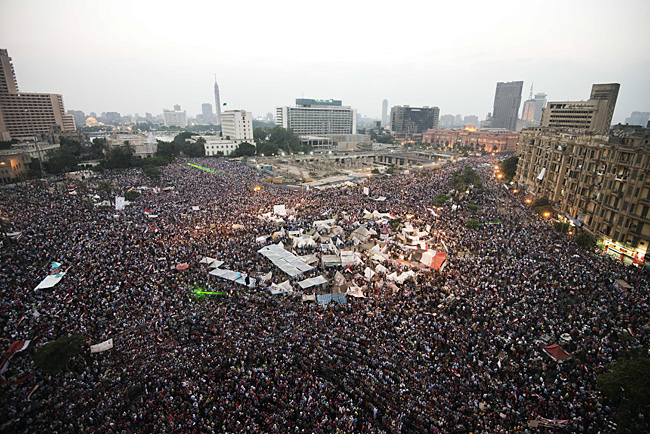
     “You either die a hero, or you live long enough to see yourself become the villain”; Mohamed Morsi is officially irrelevant in the lives of Egyptians. “Come here O Sisi,” a protestor's flag beckoned the attention of the military's general, “Morsi isn't my president.” General Abdul Fattah al-Sisi lived up to his promise just two days ago that the military would aid the protesters in overthrowing the president; he announced only hours ago that Morsi is no longer in office, that the constitution is now suspended, and that the head of the Supreme Constitutional Court, Adli al-Mansour will act as interim head of state. Sisi stated that while Mansour will temporarily serve as the head of state, he wishes to quickly move forward with early presidential and parliamentary elections, a panel to review the constitution, and a national reconciliation committee designed to bring all groups together to move the country forward.
     The last four days in Cairo outside the Presidential Palace have marked record breaking protests with millions of people in attendance, but statistics of a different nature have indicated a digression from the main purpose of the movement; around 46 sexual assaults have been reported as well as the death of sixteen people and around 780 people sustaining injuries. Despite the alarming statistics, protestors have proclaimed that this is a resistance held in civil disobedience and that such actions are unacceptable and damaging in Egypt's new fight for a fair democracy.
     As Morsi supporters— who happen largely to be proponents of the Muslim Brotherhood— have illustrated, the voices of the people were answered when Morsi was elected by over 13 million votes last June. However, as emotions tend to run wild when freedom and liberty can be just as easily lost as they are won, Morsi and the Muslim Brotherhood were seen as the necessary option for presidency considering their large role in reclaiming the country in 2011 from Hasni Mubarek, former dictator of Egypt (recall the evolution of France's 3rd, 4th, and 5th Republics).
     A year to change not only a political climate, but a socio-economic climate is a very small time frame for a very large task. But is this movement against Egypt's first democratically elected president in years a show of restlessness and rejection of democracy or is it a period of enlightenment for the people of Egypt? That is, have the people of Egypt come to the realization that their revolutionary heroes may not necessarily be suitable to lead their new government? This is a consideration that democracy has not at all failed, that, in fact, it has not yet prevailed for Egypt. For a people who are still used to and who are still in reminiscence of dictatorship, perhaps graduality is a bit much to ask and a more radical change is in order when leadership fails.
     President Morsi's only response to his expulsion is rejection— that the military has formed a coup against him and that he is still Egypt's leader. In addition, President Morsi explicitly instructs the people of Egypt to abide by the constitution while matters are being settled. Though General Sisi has suspended the constitution and though Morsi may not realize the implications of his words, this indicates to the people that their inalienable rights are still to be taken seriously. Such a message seems to be exactly what the leaders of every great nation convey whether they continue to hold power or not. In essence, Morsi is conveying to the people that their rights are more important than his dispute with them and the military.
     What we are seeing in Egypt right now is the failure of a cabinet much like failures we have seen in our own political history (the Nixon and Clinton impeachments). This does not necessarily mean Egypt is becoming anti-democracy or anti-government— they are simply anti-Morsi-government. They have found that the elections of June 2012 were a grave mistake and their civil demonstrations should show that they wish to correct this mistake.
     After nearly a week of unrest, Mansour will be sworn in tomorrow, Thursday, July 4, and a new, albeit brief chapter will begin for Egypt and its people.
~ Joe

Tuesday, April 16, 2013

On the Boston Marathon Massacre


     In the twenty-first century, evil hath no face. The general prejudice of Americans— particularly white Americans— causes us to picture brown skinned, turban wearing individuals who believe in Allah (simply Arabic for Yahweh, which is Hebrew for God). 
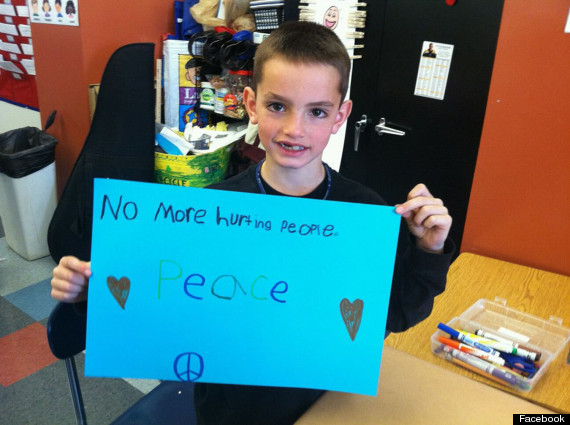
     Prejudice aside, we have absolutely no idea who is guilty of the terror at the Boston Marathon. Earlier today, I saw a picture of the child who was killed on Boylston Street and I found myself haunted not by the death of a child holding a sign that says "No more hurting people; peace", but by the apathy toward this tragedy and my own struggle with a severe disconnect to the violence. For the sake of brevity, in the case this act of terror is found to come from an individual who is domestic, American born, and perhaps even white, what I propose is that we as Americans are to blame for we have become entirely unmoved by violence and the horror violence creates. 
     It will be easy to condemn a foreign entity with foreign agents of terror, but what are we going to say if it happens to be an American? Furthermore, what are we going to say when we are forced to ask ourselves how different this is from the Colorado Shooting or other atrocities especially if those involved do not suffer from mental health issues, but from indoctrination? 
     A second set of questions: "who do we blame?" and "who do we kill?" The killing cannot stop at Boylston Street if we seek justice as we understand it in the law books  But in a spiritual sense, are we willing to send these individuals to their virgins? Or, if that was not the case, how many should be sent to their deaths to obtain justice for those who have been murdered? The pursuit of justice, in this case, should be inflection and change in our hearts, to stop violence when we see it, and to put a stop to the ever increasing sociopathic tendencies toward violence. We should confront ourselves with these things in the attempt to dissolve them completely. 
     President Obama referred to this attack as a tragedy and he has been hounded by news syndicates to condemn it further, to upgrade it from "tragedy" to something else— an "act of terror" or some such over used, over glorified phrase. That is the problem. We are already so disconnected from the tragedy, we seek to call it something else and to defend it to the end simply because we are becoming less and less able to empathize with the victims. This is a tragedy and people need to get upset over it and grieve for humanity as a whole rather than letting it fuel their prejudices and serve as entertainment to their boredom. 
     In the twenty-first century, evil begets apathy, thus evil reigns with a swift dominance of the globe. It coasts effortlessly like a feather in a vacuum gives way to Earth's gravity. The compassion we once had as a species, though still present in certain circumstances, was once a friction to violence and the evil born from it.
~ Joe

Saturday, February 23, 2013

Solar energy and "chemtrails"


     A recent Fox News article about leaks from six nuclear tanks in Washington State had momentarily sent my thoughts back to a certain article I had written about before, the premise being that America shouldn't go to solar energy since Germany gets more sun exposure than North America. This sent my mind spiraling into a certain line of reasoning and logic which is probably false, but an interesting notion all the more.
     It seems as though there is much sentiment against solar power above nuclear; even when talking with very left leaning individuals, when asked about solar power, they always seem to think it's a good idea, but that it isn't necessarily marketable next to petroleum, coal, and nuclear. If German solar power is putting out, on average, twenty times the amount of energy a nuclear plant does, the cost of creating a solar plant must cost an arm and a leg! Alas, Germany seems to be the most sound economy in Europe during this recession, so we know that this can't be true since such a cost in this industry would have put Germany below France and England, the European Union would be in shambles, and the American Dollar would be worth much, much more than the Euro. (Note: Chancellor, Angela Merkel, has stated that Germany's economy is unsustainable. If we consider solar power's eventual environmental and economic sustainability, then we know it will one day leave the market; eventually electric power will become nongovernmental and non-corporate which means it yields no economic opportunity for anyone and that there will be nothing like it to replace it. If Germany does not address this issue in an environmentally and economically friendly fashion, then it follows that Germany's economy will one day fail. In essence, the Chancellor's stance on energy is not pro-petroleum, pro-nuclear, or pro-coal per se, or even that it is anti-solar, but it is on the economic ramifications of complete independence and that living “off the grid” will essentially become living “on the grid.” Be that as it may, practical application of solar power shows that it is the environmental and microeconomic answer to our problems, and it needs to be used, here, in America).
     Considering the dangers of solar power would surpass even the dangers of nuclear power— since we must obviously bury the dangerous, ozone piercing, ultraviolet rays to lie dormant for thousands of years— maybe it's best we just make due with what we have and what we know. However, this sarcasm started me off on another tangent of thought. . .
     I'm not sure if anyone remembers the conspiracy theory about “chemtrails”: exhaust-like trails from aircraft. If you know even the least bit about aircraft, you'll know that such an exhaust in the upper atmosphere is unlikely, so, naturally, you may ask yourself what it is. (Note: I am not citing anything thus far, so I may not be completely accurate, but my memory usually serves me well with these things). The thesis of the conspiracy assumes that the chemtrails contain inoculations and anti-viruses which a majority of people refuse to take (the most radical of the conspiracy assumes the trails contain mind-numbing or controlling solutions). In order to quell these alarming theories, the United States government came forth and stated that the chemtrails were an attempt to release aluminum oxide into the upper atmosphere to combat global warming. What aluminum oxide does, in theory, is act as a second “ozone layer”; it deflects/absorbs energy coming from UVB and UVC rays. If this is in fact what the chemtrails are for, it means that the damage CFC's (typically, in aerosol) have been doing to the ozone layer are worst than previously imagined.
     What aluminum oxide does to the human body, however, should be of more concern. It has been known to cause cancers and other developmental issues in infants and children such as autism and aspergers. If it wasn't enough that damage to the ozone layer has been causing subjection to UVB and UVC rays which cause cancer, we have essentially been dumbing down the world population by accident.
     It's evident, now, that the disregard of solutions to economic and environmental issues, such as solar, stem from the “accident” of trying to manufacture the solution rather than resurrect it. In essence, the only way to attribute intelligence to this “solution” is by discovering that the “solution” was worked out of malice; if we decide it was worked out of benevolence, unfortunately, this means it came from ignorance.
     In many less words, my working thesis is this: maybe we aren't making the right choices because of the consequences of our wrong decisions. Maybe we don't pick the correct solution because we are, in fact, growing stupider, as it were.
~Joe

Wednesday, February 13, 2013

An American response to Winston Churchill on conservatism


     Without accusing what was possibly one of the greatest minds of the twentieth century as being nothing more than a drunk, excusing the fact that his diminishing popularity was likely due to an ever increasing conservatism (which will be explained shortly), and outright ignoring the fact that this phrase is mistakenly attributed to him, Winston Churchill makes a grave mistake in saying: "If you're not a liberal when you're 25, you have no heart. If you're not a conservative by the time you're 35, you have no brain."
     What this quote ignores is the natural and historic tendency of political and economic leanings and how they relate to the morphing society's affect on the aging individual; in essence, progressivism naturally challenges “the lifestyle” being that enhancement of all facets of society and of living means a change at all the levels of living— a perpetual alteration. The discomfort with this grows when we become accustomed to a certain living style; as we are all members of a culture or of a subculture, the “we” knows no bounds of economic status, thus, the discomfort of change affects the poorest of us as well as the richest of us. Where the commodity becomes a fetish, the tendency of progressivism is a turnoff because we consider the prospect of stagnancy (at best) or steady decline (at the worst) to be greater than the idea of change at every turn (— interestingly, this attitude seems to be contrary to the way the capital market is designed to work).     This is essentially psychology on a grand scale; how does time affect the individual's perception of reality? My grandfather once told me that when he was my age, he thought that at his age society and government would be entirely different, that it would be more forgiving to “the small guy.” Working for decades at General Motors in Connecticut, he understood the powerful infrastructure that he and his parents were preparing for the future: technology, money, social programs, new age culture, drive, service, specialty, wealth with no poverty, a unified class. Now, he can't believe what he is seeing; things have not just gone stagnant, they have become worse, and reality seems to be very surreal for him and people of his generation.
     My grandfather is a liberal; he supports strong government programs for the poor and working class, strong taxes for the rich, foreign diplomacy over war, and large spending and reform in education. He went into retirement for less than a few years after the plant closed only to come back out to raise two of his grandkids with my grandmother, and suddenly he needed to continue finding work (which he was fortunate enough to do). No one has had to adapt to change more than my grandparents, and they are just fine doing that. Why can't change in our government and society serve people like this and, more importantly, change the work ethic and education of those who aren't so driven?     The reason why Churchill's quote is considered correct is because it is always attributed to a single divine and/or logical truth when the fact of the matter is that the prospect of attaining the individual, single self interest (a la state of nature) guides the destiny of the society— the idealism and societal goals set forth by not only our forefathers, but our younger minds are trampled by the insecurity and comfort of our elders. The idea and ideal of progressivism becomes taboo along with what younger minds have to offer and sacrifices made by hard working people are either ignored or considered expected of everyone including those who are not equipped to do so.
     So when you find yourself growing increasingly defensive of the policies and practices of yesteryear, reflect on your life choices and ask yourself why. Do you have something to gain by putting a stop to change in your society? If you don't have anything particular to gain, ask yourself who does; if we can consider that, traditionally, the bottom line is the dollar, then those who would not profit from societal and political change are those who will fight the change. And those who fight the change use propaganda to capitalize on the discomfort that change inevitably creates in an individual. Instead of empowering people to “do what feels right”, people are being forced to react negatively to things that make them uncomfortable rather than to facilitate the change and to acclimate.     Close your eyes for a moment and picture your life between the years of twenty-five and forty (even if you fall into or beyond the range, imagine how things have unfolded); you have to imagine all the complexities of early life: first or second career or your fourth or fifth dead-end job, college debt is in it's young years if you have it and if you don't, maybe you have a slightly nicer apartment or car than the average college student, but essentially you are in the same position; in fact, maybe you're simply unemployed and desperate for even a part time, minimum wage employment. By the time you're forty you are settling into a routine, a specific kind of lifestyle; now you probably have a serious relationship or partnership and you are beginning to make good money— enough to buy a home or take on debt to buy a home (if you haven't already).
     Now open your eyes. In your later years, things become easier in some ways and harder in others and your memory starts becoming selective; it begins to ignore moments or sentiments of the past because they no longer serve your self-interest. Even if life isn't as you've imagined it would be, you start accepting your disposition and you become comfortable with it— in fact, you reach the point of defending it.
     Any change to serve those currently in the position you used to be is threatening if you're lead to believe it will only reduce you back to that position or at the very least make your current state of being unsustainable without further effort; a small part of you feels no responsibility for those who are like you once were as those who used to be where you currently are did for you. Ritual and habit becomes easy and the added responsibility of the future generation and less fortunate threatens the simplicity and/or comfort of your living.
     This is entirely justifiable; you are here, now, and you're not entirely happy, but you are safe and comfortable. Future generations will be able to do the same and the less fortunate will be able to follow suit when they change the ways they make choices— voila, you are now conservative.
     That being established, it is a sound assumption that the simplicity of your living (or at least the comfort) is, in fact, threatened by change. Social issues begin to take precedence in your political leanings simply because this is not how things used to be, and things used to be just fine for everyone. Some of the changes being made aren't necessary at all, so shunning new ideas becomes second nature.     Change is inevitable, imminent, and perpetual whether we like it or not, whether we are ready for it or not. Preservation of tradition and tradition itself are admittedly important to the identity of a culture and society, but sacrifices must be made to preserve the underlying values and necessities that make the good society what is good. A “get-what-you-deserve” society cannot exist within the conditions our forefathers set before us because we already accept that a life void of liberty and of the means to life is not representative of the American dream; in other words, the most successful and comfortable of us all must make sacrifices to allow the less fortunate to thrive. Separately, to mark self-preservation as an individual concern is foolhardy since the purpose of our independence as a nation was its guarantee.
     This is the fallacy I find in Winston Churchill's supposed phrase. Though it may only pertain to our society in the framework of my argument, I still find us to be the greatest society of all, and all those wanting for the good society should consider this argument.
~Joe

Sunday, February 10, 2013

Math needs better marketing

     "What is your measure for support of science? Is it what anybody says, or is it where money gets spent? Basically, in Washington, it's where money gets spent. Sensibly.... the only point of Congress is to spend the three trillion dollars of the budget each year, and how you spend it is the portfolio of what defines this nation. Period." That's Neil deGrasse Tyson speaking about how important science is to America. The video is titled "Who's More Pro-Science, Republicans or Democrats?"
     Dr. Tyson goes on to explain that, historically, Republicans have been kinder to science than Democrats. He states, specifically, that under the Bush administration, different science communities received more money from the government like NASA who received a 20% increase. Under Clinton, however, NASA's budget dropped by 25%. However, Dr. Tyson reveals his disdain for the Republican party when he explains that increases to science education on behalf of the party usually include creationism which is ultimately more deadly to education than a small budget.
     "The innovations and creativity in science, engineering, technology, and math will be the drivers of tomorrow's economy— jobs.” In a separate interview with CNN, Dr. Tyson explains why math and science are so important in education despite some scholars “never using math again”; "Whether or not you ever again use the math that you learned in school, the act of having learned the math established a wiring in the brain that didn't exist before, and it's the wiring in the brain that makes you the problem solver... Even if you don't want to become a scientist, the minimum you should ask of yourself is that you become scientifically literate... and mathematically literate because therein are the engines of problem solving in the world... Now you're valuable to an employer [who seeks to innovate]."
     It appears that those, like me, who have busied themselves so much with argumentation, logic, reasoning, and progressivism and left math and science as a field of "other study", as a non-facet of the issues at hand, are gravely mistaken and lacking in our endeavor for answers and solutions. And it saddens me that this makes out to be the most sound argument I have ever made. 
     I draw out the example of showing one's work in affirmation of an answer. Any and all arguments made without the structure required for proof aren't good enough even if it provides the correct answer. What Dr. Tyson is saying that math and science can do is help us understand all the "why's". A socialist can be so convinced that heavy tax on the rich and national social programs reaching into the hundreds are what will save this nation and, similarly, a libertarian can be so convinced that stepping completely out of peoples' lives is the ultimate solution for prosperity, but without a body of evidence and proof between the introduction and conclusion for each argument, all we have is a sales pitch. 
     Without further ado, I shorten Dr. Tyson's argument to a single, simple statement: "Math and science directly lead to the innovated and perfected world of tomorrow," but as Dr. Tyson puts it, "math needs better marketing."
~Joe

Friday, February 8, 2013

The credibility of Fox News is sinking and why


     Stating that Fox News is the least trusted news source for Americans is generally accepted as “stating the obvious” (even some conservatives must make up the 46% of people who outright condemn the network). But a recent poll by the New Public Policy Polling finds Fox News Network at a four year low in approval rating; in addition to this, those who do not trust Fox News Network are most likely to trust any alternatives to the network for their news (even renowned liberally leaning networks such as MSNBC).
     We have to ask ourselves, though, why are less and less people buying into the conservative bias? A liberal might say “because people are becoming more enlightened” (a less polite liberal may say “because people are becoming less and less stupid”). In any case, the intelligence of Fox News viewers and former viewers likely has nothing to do with this outcome.
     Consider this: the Republican Party, specifically, is changing— it is most likely breaking apart, at best, or outright falling apart, at the worst. If we consider the conservative-Republican favoring bias which Fox News Network represents, we have to ask ourselves how is Fox breaking apart and/or in which direction is Fox News heading?
     Sparing ourselves the liberal sentiment (“Fox News is going down”) and taking the question seriously— as though bias is a neutral or good thing— we can see that Fox News is becoming less and less popular amongst Republicans and conservatives in general because it is only appealing to the neo-liberals and ultra conservatives (remember, neo-liberal and ultra conservative are essentially the same thing nowadays).
     Now we ask why Fox News is appealing to a specific grouping of conservatives rather than the entire body of conservatives. The answer is actually quite simple: an agenda must go to extremes in the hopes that falling short may result in the desired outcome. When such a rift occurs in the same movement, all that agenda can serve are the targets that have clung to those extremes.
     Therefore, it's my prediction that as Republicans in the socio-political realm separate themselves as “Tea Party” members or right leaning libertarians (as well as some conservatives setting themselves apart from those identities), Fox News will continue to crumble until the bias it presents is so thickly riddled with the radical that it will seem “Onion”-ish to Democrats and a majority of Republicans alike (as it already appears to be doing).
     On a slightly separate note, I'd like to address the conservative concern for liberally biased media. If we consider the number of folks who prefer any other network to Fox, what we have is not a plurality of news viewers who prefer a liberal network, but a plurality of news viewers who prefer not to watch a specific network for a specific reason. MSNBC may be notoriously liberal, but that's not all people are watching. The only people who seem to continue watching Fox News Network are those who refuse to watch anything else because they deem nothing conservatively appealing enough, and it is the pursuit of a bias which should not matter in the face of receiving truthful and factual information and that fact is ultimately the reason why the network is failing. (As far as the reliability of American news in general— only a separate article can address that concern). 
~Joe

Notable links:

Thursday, February 7, 2013

A short thought on education

     I must admit to an embarrassing fact: in my last post, I incorrectly referred to the late Christopher Hitchens as "Dr. Hitchens". I have since corrected it, but it has sent me on an interesting train of thought. 
     It used to be that success was not necessarily defined by the education behind an individual. In the 1980's and 1990's it was apparent that the opposite was becoming true; if you wanted a secure and well paying job, you went to school, and, of course, if you wanted to go through trade school to learn how a specific trade, there was always that option. 
    Now it is 2013 and Haley and I are sitting here willing ourselves through the graduate school application process. It's just as tedious, if not more-so, than the undergraduate process, and the monotony is admittedly killing me as it is many of those whom I know are subjecting themselves to the same thing. I ask myself, "why not give up? Why not just get a job and work towards a lifelong career like Hitchens did?" 
     The United States Department of Labor states that in 2012 employment tenure was at an average of 4.6 years which means the average working adult will have between seven to ten (7-10) jobs in their lifetime. We can see, already, the disincentive of dropping straight into the work force. After all, even if education serves less of a purpose in obtaining success, if I stay in school for the next two to five years, maybe I'll only have to subject myself to between four and seven separate careers instead of up to ten.
     But why is it now so hard to find a career to enjoy? For example, it's now been roughly sixty six days since I graduated from college and I am still unemployed. Taking winter breaks into consideration as well as not having moved into a new apartment until the beginning of January, we can chalk it up to a solid two months of hunting jobs. The jobs I've been avoiding are fast food service, cashier attendance, restaurant service, and the like, but it appears that what I have been avoiding is going to be my only option, in the end, when one of us can no longer carry both. But I digress.
     Back to the issue of "why education?" As I said, trade jobs used to be highly popular before the turn of the century. We could even say that trade jobs are the sole reason (ahead of education) why this country is as great as it is, but as we see less and less people going into trade to live with a job they love, we see society brooding more and more about a monotony in life. 
     Yes, I did refer to the graduate application process as monotonous, but it's not exactly the same thing. This type of discouragement is temporary; eventually the applicant receives word back from the institutions he or she applies to and chooses the best option (even if it is applying again for the next semester). The type of discouragement in society to which I refer is not temporary; it is permanent, perpetual, and it forces those who are stuck in it to indoctrinate themselves with new reality. 
     Thus, the new age of education is in selflessness. Yes, one could pursue education merely to put off the horrors of "the real world", but the proper function of education nowadays is to attempt changing the way the world works, to making the "dream" something that can actually be realized. Some of us are making this attempt in writing, art, theatre, business, and by becoming an educator, but I am making this attempt in politics and hopefully journalism because the struggle is, ultimately, convincing people not only that change should come, but that it can and it takes individual effort and cooperation— the same individual effort and cooperation that created this great country.
~Joe